The aiTriage™ platform
How aiTriage supports chest pain assessment
Record a five-minute ECG, review the risk report and use the result alongside your clinical assessment.
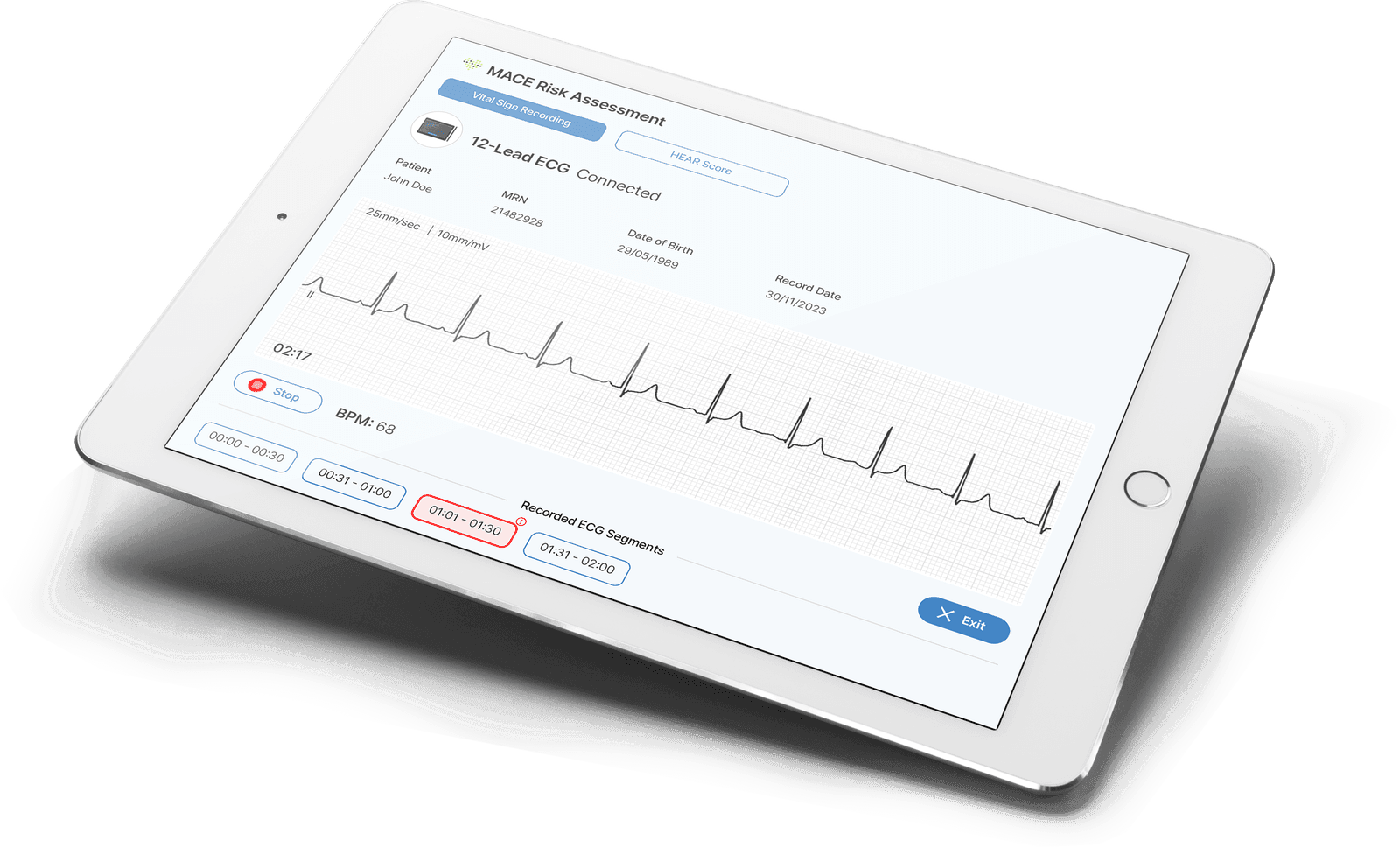
How it works
Three steps from assessment to report
The ECG recording takes five minutes. The report follows after analysis.
- 01
Enter the assessment inputs
Enter vital signs and HEAR assessment inputs.
- 02
Record the ECG
Record five minutes of 12-lead ECG. The application checks signal quality during recording.
- 03
Review the risk report
Review the patient's predicted major adverse cardiac event (MACE) risk alongside the ECG and assessment inputs.
Heart rate variability (HRV) features from the ECG are analysed with the assessment inputs.
What clinicians see
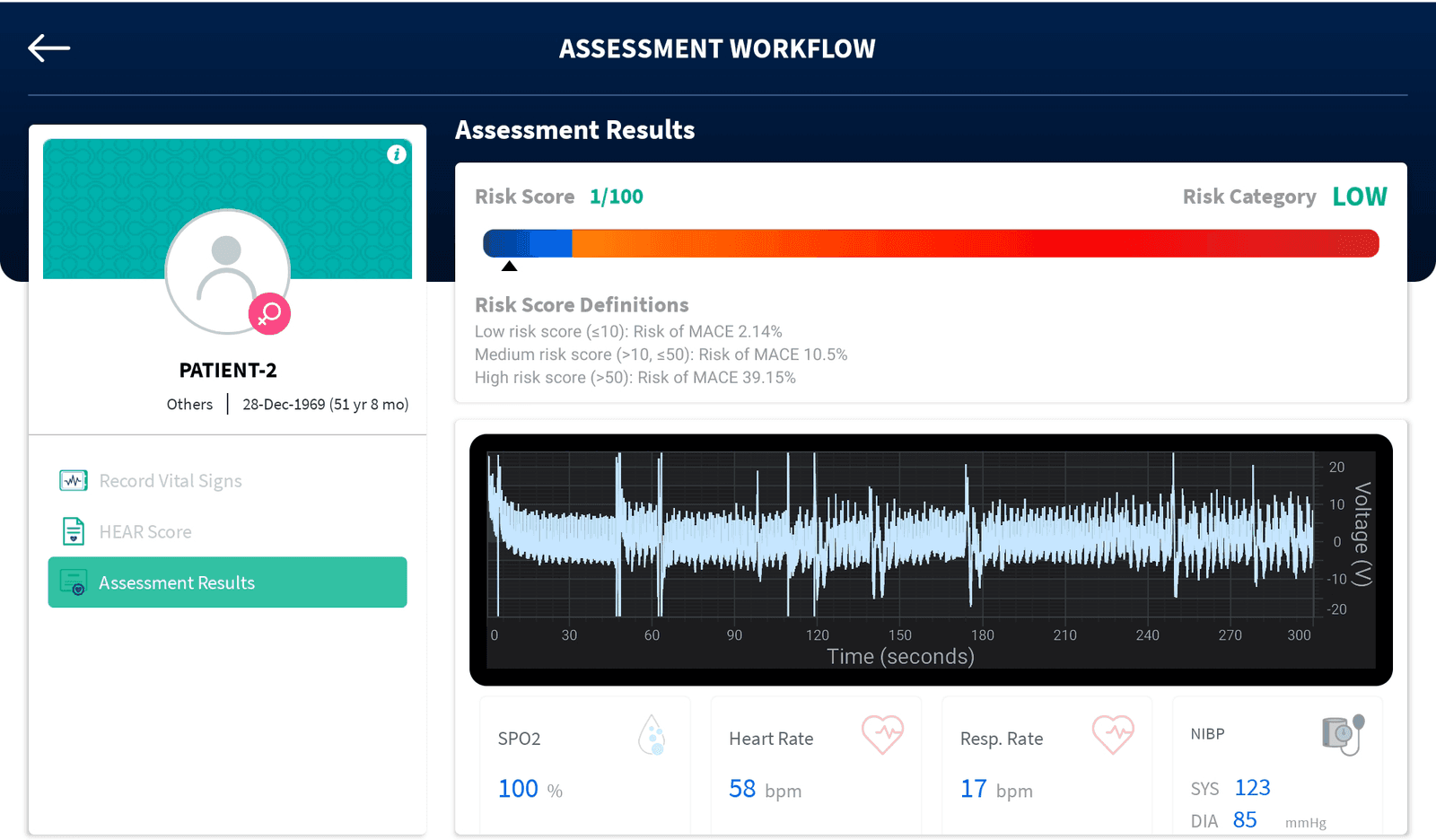
Review the aiTriage risk report
Review the risk score alongside the ECG and assessment inputs.
- An objective risk score from 0 to 100, with the MACE risk category
- Low, medium or high category, with the reference MACE rate for each band
- ECG trace, vital signs and HEAR score inputs kept visible for review
Equipment and setup
Our team will confirm equipment compatibility, connectivity and integration requirements for your site.
Review regulatory documentation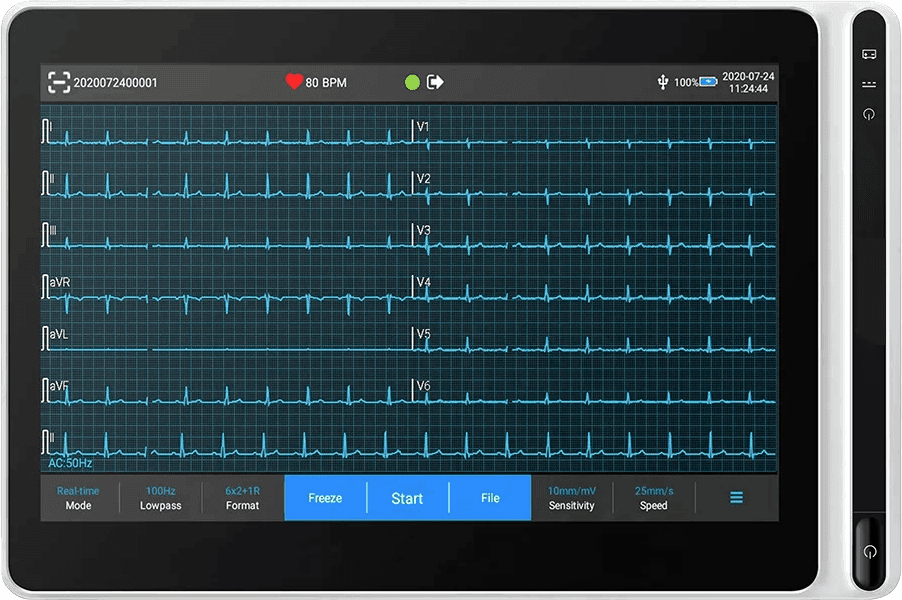
The science
Heart rate variability research since 2010
Heart rate variability (HRV) reflects the balance between the sympathetic and parasympathetic nervous systems, and that balance shifts measurably in patients heading toward a major adverse cardiac event. aiTriage extracts HRV features from a short ECG and pairs them with the signals clinicians already collect. The approach has been evaluated against established risk scores such as TIMI in peer-reviewed studies.
Selected publications
aiTriage v2.0 conference abstract
Journal of the American College of Cardiology, 2026
Performance of a novel multimodal machine learning risk stratification tool (aiTriage v2.0) for chest pain patients presenting to the emergency departmentPilot randomised controlled trial
Clinical and Experimental Emergency Medicine, 2026
Pilot Evaluation of a Novel Artificial Intelligence (AI) Heart Rate Variability (HRV)-Guided Risk Stratification for Chest Pain in the Emergency Department: A Randomized Controlled TrialProspective observational study
The American Journal of Emergency Medicine, 2013
Heart Rate Variability Risk Score for Prediction of Acute Cardiac Complications in ED Chest Pain Patients
Common questions
Who makes the clinical decision?
The clinician reviews the risk report alongside the ECG, assessment inputs and local pathway. aiTriage does not replace clinical judgement.
Is troponin a required input?
Inputs vary by supported product version and assessment mode. Ask our team which inputs apply at your site. Blood testing remains part of the clinical pathway when required.
Discuss aiTriage for your site
Book a 20-minute walkthrough with our team.